


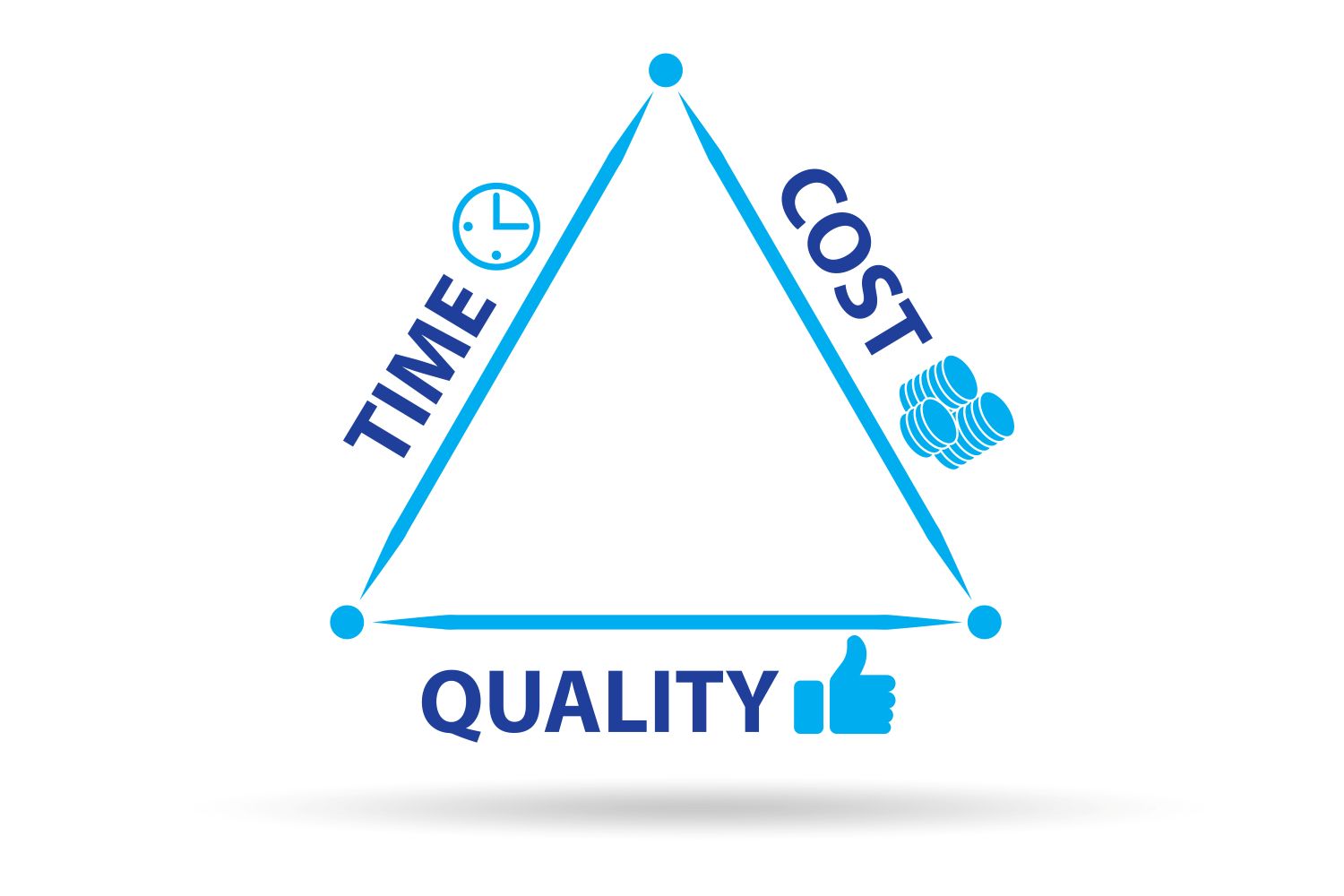
AI project management often borrows a reflex from classic software work: the cost, time, and quality triangle. You cannot optimize all three corners at once. Cutting corners on one always affects the other two.
In a traditional software project, all three constraints stay fairly legible. You roughly know what you are building, you can measure progress, and quality often comes down to a test that passes or fails.
An artificial intelligence project bends each of these three corners out of shape. Cost does not scale linearly. Time moves at two very different speeds. Quality, meanwhile, is never really stable over time. These three shifts change how you plan, budget, and make decisions on an AI project.
The Cost of an AI Project Is Not Linear
The most common blind spot in AI project management is scalability. Two setups come up again and again, and each hides its own trap.
API Calls
Usage-based billing looks simple at first glance. It is indexed to the volume of tokens processed, and at low usage, the unit cost seems negligible. The problem shows up once volume grows. Ten thousand requests a day at standard pricing can easily add up to more than a thousand dollars a month, and that figure climbs fast depending on the model you pick.
According to Zylo’s 2026 SaaS Management Index, based on an analysis of more than 75 billion dollars in software spend, 78% of IT leaders surveyed had run into unexpected charges tied to usage-based or AI pricing models, up from 66.5% a year earlier in the 2025 edition of the same report. Another telling figure from this latest edition: 61% of organizations had to cut projects because of SaaS cost increases they had not planned for. In practice, the industrial-scale scenario needs to be modeled before choosing an architecture, not after.
Hosted Solutions
Cost here looks fixed and predictable. In reality, it follows a curve that is anything but.
Engineering is almost always the heaviest line item. Running AI in production demands MLOps, DevOps, and security skills, and depending on the setup, these skills can account for a significant share of the annual budget.
Either way, three-year total cost of ownership typically lands at 1.5 to 2 times the initial build cost once you factor in maintenance, retraining, and integration. Separating build cost from operating cost right from the scoping stage saves a lot of unpleasant surprises down the line.
The Timeline of an AI Project Management Moves at Two Speeds
The build phase of an AI project moves fast. A model comes together, gets integrated, and gets validated on an initial dataset within days or a few weeks.
The next phase runs on a completely different logic. Testing on real data, iterative adjustments, edge case handling, team adoption, compliance work, documentation, monitoring: this phase has no clean finish line. It stays structurally open-ended.
That gap between “it runs” and “it’s reliably in production” is where most of the tension in AI projects comes from. Technical teams often consider the project done well before the system is actually operational from a business standpoint.
McKinsey’s State of AI 2025 report, drawn from nearly 2,000 organizations across roughly a hundred countries, backs this up. Only about a third of organizations report having actually scaled AI across the enterprise, despite very broad adoption elsewhere.
In most AI projects, the build budget gets approved upfront, but the operating budget does not exist yet by the time teams start shipping. Trade-offs then get made under pressure, right when they should already have been settled. Building both phases into the initial scoping lets you treat the move to production as a considered decision rather than a last-minute negotiation.
Quality Is the Hardest Variable to Stabilize
This is the corner of the triangle that sets an AI project apart most from a traditional software project, and the hardest one to control in the era of generative AI.
The starting question sounds simple. At what point does a model produce a good result? Yet it remains one of the least well handled questions in these projects. A statistical performance threshold, precision, recall, or F1 score, is not enough to answer it. A model showing 92% precision can turn out to be unusable if the remaining 8% of errors consistently fall on the most sensitive cases, the most exposed clients, or the most irreversible decisions.
It falls to business stakeholders to define this before the build starts. What level of error is tolerable? For which category of decision? With what human oversight mechanism when there’s doubt? These answers directly shape the model choice, the validation architecture, and the monitoring setup.
That first piece of groundwork feeds directly into the second dimension: how well quality holds up over time. A poorly set threshold at the start makes drift even harder to detect later, because you no longer really know what you’re watching for or when to raise the alarm.
An AI system degrades over time. The data changes (data drift). Behaviors evolve (concept drift). The business context shifts. A model validated at launch can deliver increasingly unreliable results six months later, with no technical error visible on the surface. This corner of the triangle moves independently of anything the team decides, which is exactly why a monitoring setup needs to be built in from the start, along with regular reassessment of real-world performance.
What This Means for Running an AI Project
The cost, time, and quality triangle remains a useful tool for AI project management, but using it well requires three shifts in posture.
First, identify the non-negotiable constraint before you start. This is a business decision, not a technical one. In a regulated environment, decision quality often outweighs delivery speed. In a highly competitive context, it can be the reverse. Architecture, budget, and schedule should all follow from that choice, not the other way around.
Second, model cost at scale before choosing an architecture. A unit cost that looks controlled at low volume tells you nothing about the real cost at ten or a hundred times that volume. Comparing API calls against a hosted solution needs to account for engineering, maintenance, and governance costs, not just token or infrastructure costs.
Third, treat quality as a living variable. Define the business metric upfront, plan for monitoring in production, and set aside operational capacity for adjustments after launch. An initial validation is never good for the entire lifetime of the system.
Sources
- Zylo, 2026 SaaS Management Index. Survey of 218 IT leaders, based on more than 75 billion dollars in managed SaaS spend. https://zylo.com/news/2026-saas-management-index
- Zylo, 2025 SaaS Management Index (source of the original 66.5% figure). https://zylo.com/news/2025-saas-management-index/
- McKinsey, The State of AI 2025: Agents, Innovation, and Transformation. https://www.mckinsey.com/capabilities/quantumblack/our-insights/the-state-of-ai
- Uvik Software, AI Development Cost in 2026: Full Pricing Breakdown. https://uvik.net/blog/ai-development-cost/
Read more : Claude Code leak: it’s not the model that leaked, it’s everything around it