

In October 2025, Gartner listed multiagent systems among its 10 top strategic technology trends for 2026. The firm also predicts that by 2027, 1 in 3 agentic AI implementations will combine agents with different skills to handle complex tasks. For those agents to work together, someone has to conduct.
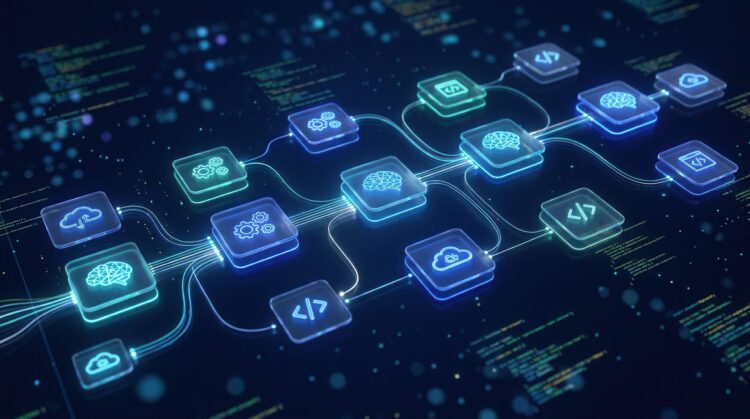
The idea behind an AI agent orchestrator is easy to grasp. A central agent receives the goal, breaks it down, hands each piece to a specialised agent and puts the results together. Studies published since 2025 show, however, that this architecture sharply improves some results and degrades others. Telling the 2 situations apart saves companies from expensive projects that deliver nothing.
Why an AI agent orchestrator
A single AI agent works well as long as the task stays contained. When the task grows, the agent runs up against its working memory. A language model can only handle a limited amount of information at once, known as its context window. Ask it to go through 40 documents, query 3 software tools and then write a summary, and that memory fills up while quality drops. A single agent is also slow, since it runs its searches one after another.
The orchestrator gets around these limits by splitting the work. Each specialised agent has its own context window, its own tools and targeted instructions. It sends back to the central agent only the essence of what it found.
One distinction helps. Anthropic, the company behind the Claude models, separates workflows, whose steps are fixed in advance in code, from agents, which decide for themselves how to proceed. An AI agent orchestrator belongs to the second group: it decides along the way how many subtasks to create and who should handle them. Many tools sold as “orchestrators” are in fact workflows. For a stable process, that is often the better choice.
What an orchestrator does
Its role comes down to 4 operations. It breaks the goal down into subtasks. It delegates them, giving each agent an objective, an output format and clear boundaries. It checks what comes back. It assembles the final answer, or sends an agent back out if something is missing.
Anthropic has described this set-up for Claude’s research feature. A lead agent analyses the question, works out a strategy and launches several subagents that search in parallel. A final agent checks that every claim in the report points to a source. The company stresses the quality of delegation: with instructions that were too vague, its subagents repeated each other’s searches or left gaps. Its early versions sometimes spawned 50 subagents for a simple question.
For technical teams: MCP and A2A
2 open protocols now underpin these architectures. The Model Context Protocol (MCP), released by Anthropic in late 2024, standardises how an agent connects to tools and data. The Agent2Agent protocol (A2A), introduced by Google in April 2025, handles communication between agents, including agents from different vendors.
Both now sit within the Agentic AI Foundation, set up by the Linux Foundation in December 2025 with MCP among its founding projects. A2A joined in August 2026. On the development side, frameworks such as LangGraph, CrewAI or Microsoft Agent Framework provide the orchestration building blocks. Anthropic nevertheless recommends starting with direct calls to the models, because these abstraction layers make debugging harder.
The benefits, in figures
On tasks that split well, the gain can be measured. On its internal research evaluation, Anthropic found that a lead Claude Opus 4 agent working with Claude Sonnet 4 subagents outperformed Claude Opus 4 on its own by 90.2%. The example given was finding the board members of every information technology company in the S&P 500. The single agent, searching for names one by one, did not manage it.
Parallel work also saves time. By running 3 to 5 subagents at once, each using several tools simultaneously, Anthropic cut research time by up to 90% on complex questions.
An independent study confirms the gain while narrowing it down. In December 2025, researchers from Google and MIT compared 180 agent configurations. On a financial analysis task that was easy to split, centralised coordination (in other words, an orchestrator) improved performance by 80.9% over a single agent.
The architecture also has a quieter security benefit. An agent with a narrow role can be given access limited to the strict minimum. It can be tested, replaced or restricted without touching the rest of the system.
Weaknesses and points to watch
A multiplied cost
According to Anthropic, an agent uses about 4 times more tokens, the units of text that model providers bill for, than an ordinary chat. For a multi-agent system, the ratio rises to about 15. The company concludes that the architecture is only worth it for tasks valuable enough to cover the extra cost.
Tasks that suit it poorly
The Google and MIT study shows the other side. On planning tasks, where each step depends on the previous one, every multi-agent variant tested degraded performance by 39 to 70%. Splitting the work fragments the reasoning. The authors also observe that adding agents brings little or even negative returns once a single agent already succeeds at the task more than roughly 45% of the time.
Anthropic makes a similar point: fields where all agents need to share the same context, or that involve many dependencies between agents, are a poor fit for this architecture.
Errors that spread
In a multi-agent system, one agent’s mistake passes to the next. According to the same study, agents working without central coordination amplify errors 17.2 times. With an orchestrator that checks intermediate results, the factor falls to 4.4. That check is therefore part of the orchestrator’s job. Without it, the whole system becomes fragile.
A team at the University of California, Berkeley analysed more than 1,600 execution traces from 7 multi-agent frameworks. Its taxonomy, presented at the NeurIPS 2025 conference, lists 14 failure modes. They include system design flaws, coordination problems (an agent ignores what another passes on, or drifts from its task) and insufficient final checks.
Security
An orchestrator reads and passes on content it did not choose. In December 2025, OWASP, an international reference in application security, published with more than 100 experts a Top 10 of risks specific to agentic applications. The first is agent goal hijack: an email or document contains hidden instructions that redirect the agent. The list also covers cascading failures, where a fault spreads from one agent to another. Known countermeasures include treating all external content as untrusted, giving each agent its own account with reduced rights, and logging every action.
The regulatory framework
The AI Act applies to uses rather than to architecture. Article 4 already requires companies to develop their staff’s AI literacy. Since 2 August 2026, Article 50 has required that people be told when they are interacting with an AI. If one of the agents takes part in a use classified as high-risk, such as screening job applications, the corresponding obligations will apply from 2 December 2027.
The GDPR adds a constraint: Article 22 restricts decisions based solely on automated processing where they significantly affect a person. The more agents there are, the more important it becomes to trace who decided what.
5 use cases by sector
The configurations below are typical examples. They show where an orchestrator adds something, and the case where it adds almost nothing.
Fiduciary firms: onboarding a new client
One agent gathers the documents received and flags those that are missing. A second compares the declared information with the official registers, while a third prepares the summary sheet. These checks are independent and can run in parallel. The risk assessment under Luxembourg’s anti-money laundering law of 12 November 2004, like the decision to accept the client, stays with the professional.
Engineering firms: answering a call for tenders
The orchestrator splits the tender documents between 4 agents. The first extracts the requirements and award criteria. The second selects the firm’s references that match the project. The third prepares a first draft of the methodology from the engineer’s notes. The last checks consistency between the technical proposal, the schedule and the price offer. The engineer reviews the whole bid before it is submitted.
Insurance: claims handling
When a claim comes in, 2 agents work at the same time: one checks the policy’s cover, the other spots inconsistencies with the claim history. The claims handler receives a prepared file and decides on the settlement. The scope needs careful setting. The AI Act classifies risk assessment and pricing in life and health insurance as high-risk (Annex III), and a fully automated claim refusal would fall under Article 22 of the GDPR.
Logistics: order processing
Reading an order received by email, checking stock in the ERP, preparing the transport documents, confirming to the customer: these steps always follow the same order and each depends on the previous one. This is exactly the kind of task where a model-driven orchestrator adds little. A fixed workflow, with AI at 1 or 2 steps (reading the email, drafting the confirmation), will be more reliable and cheaper.
Manufacturing: analysing a maintenance incident
After a breakdown, several leads can be explored at once. Agents go through the maintenance history, the manufacturer’s documentation and the sensor data around the time of the incident. The orchestrator compares their findings and proposes hypotheses ranked by likelihood. The technician chooses which one to check first.
Where to start
Before choosing a tool, 4 questions settle the matter:
- Can the task be split into independent parts? If each step depends on the previous one, a workflow is enough.
- Does a single agent already fail? If it succeeds well, adding more will bring little.
- Is the task valuable enough to cover a computing cost up to 15 times that of a chat?
- Can you check the final result and trace which agent did what?
If all 4 answers are yes, a pilot limited to a single process, with human sign-off at the end, will measure the real gain within 6 to 8 weeks. Otherwise, follow Anthropic’s advice: add complexity only when it demonstrably improves the result.
At SerendipAI, we approach these projects with a diagnostic of the processes involved, so the choice between workflow, single agent and orchestrator is made before anything is built.